Designing Agent Capabilities, Boundaries, and Control
Contents 12
- 01 Capability is not the same as permission
- 02 The best way to design an agent is with layered prompts
- 03 1. Prompt to define the agent’s role
- 04 2. Prompt to define capabilities and boundaries
- 05 3. Prompt to define memory structure
- 06 4. Prompt to define routing behavior
- 07 5. Prompt to define the instruction-file structure
- 08 6. Prompt to define approvals and control
- 09 7. Prompt to define self-correction
- 10 8. Full agent-design prompt
- 11 How I used this approach to set up my own system
- 12 Final thought
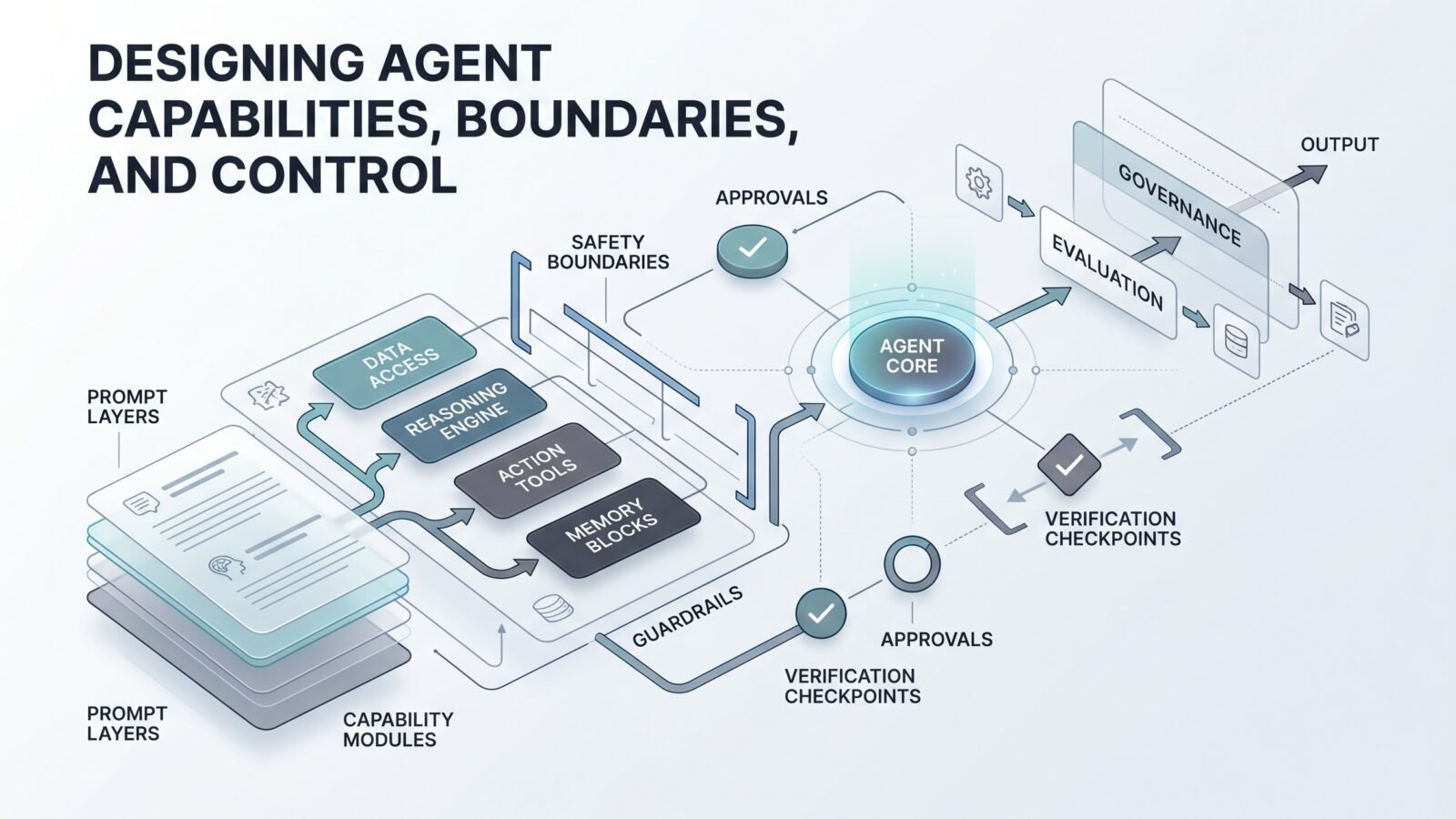
Why good agents are not built from one magical prompt, but from layered decisions about role, memory, routing, approvals, and control.
Designing a good agent is not just about adding tools. It is about shaping capability, boundaries, and control. This post walks through the prompts I would give to define an agent’s role, memory, routing, approvals, and self-correction, along with the high-level structure I used to set up my own system.
A lot of people still approach agent design backwards.
They start by asking what tools to connect, what model to use, or how much autonomy the system should have. Those questions matter, but they are not the first ones.
The first question is simpler:
What exactly is this agent supposed to be?
Good agents are not created by one magical prompt. They are built through a series of design prompts that define:
- role
- capabilities
- boundaries
- memory
- routing
- approval rules
- verification
- self-correction
That is the real design work.
This is how I think about it now. Not as “give the model more power,” but as “shape the system so it can act usefully without becoming sloppy, reckless, or vague.”
Capability is not the same as permission
One of the first things worth clarifying is that capability and permission are not the same thing.
An agent may be technically capable of:
- searching the web
- reading files
- writing drafts
- sending messages
- publishing content
- running code
- editing structured data
- calling APIs
But good design does not treat all of those as equally available.
That is where many weak agent setups fail. They give the model a wide tool surface before they have defined:
- what it should do freely
- what it should do carefully
- what it should ask before doing
- what it should never do by default
- how it should verify that it succeeded
So the real design task is not just adding tools. It is shaping access.
The best way to design an agent is with layered prompts
I think the cleanest way to build an agent is to do it in layers.
Instead of trying to write one giant perfect instruction, prompt the system to help you define the major parts separately.
Those parts are usually:
- role
- boundaries
- capabilities
- memory
- routing
- approvals
- verification
- self-correction
That already gives you a much better system than “be a helpful AI assistant.”
1. Prompt to define the agent’s role
Before anything else, define what kind of agent you want.
Example prompt
Help me design an AI agent for [purpose].

I want you to define:
- its primary role
- what kinds of tasks it should handle
- what it should explicitly not handle
- what good performance looks like
- when it should ask for help instead of guessing

Make it practical, specific, and bounded.
Why this matters: Most bad agents are underspecified. They are told to be “helpful,” “smart,” or “autonomous,” but not told what they are actually for.
2. Prompt to define capabilities and boundaries
Once the role is clear, define what the agent should be allowed to do.
Example prompt
Design the capability model for this agent.

Break it into:
- safe internal actions
- bounded execution actions
- external side-effect actions
- high-risk actions

For each category, tell me:
- what tools the agent should have
- what approvals it should require
- what verification it should do after acting
Why this matters: This prevents the common mistake of giving the agent a giant undifferentiated toolbox.
3. Prompt to define memory structure
Memory is one of the most important design decisions, and one of the easiest to get wrong.
Example prompt
Help me design memory for this agent.

I want a structure for:
- live state
- short-term working memory
- long-term durable memory
- daily logs
- summarized monthly memory
- what should never be stored by default

Also explain how retrieval should work so the agent does not overload itself with irrelevant context.
Why this matters: Persistent memory should not mean “store everything and reload everything.”
A better design is layered:
- live state for what matters right now
- daily notes for raw chronology
- summaries for compressed history
- durable memory for long-term truths
- search-first retrieval instead of broad raw loading
That is one of the strongest lessons from building my own system. Persistent memory only works if retrieval is selective.
4. Prompt to define routing behavior
Not every request should be handled the same way.
Example prompt
Help me design routing rules for this agent.

Given different request types, define:
- what context it should load
- what tools it should use
- when it should stay conversational
- when it should switch into execution mode
- when it should escalate or ask for approval
Why this matters: Routing is what makes an agent feel structured instead of generic.
5. Prompt to define the instruction-file structure
Once the behavior is clear, it helps to externalize it into a small file structure.
Example prompt
I want to build this agent using simple instruction files.

Please propose the purpose of files like:
- IDENTITY.md
- SOUL.md
- STATE.md
- MEMORY.md
- ROUTING.md
- TOOLS.md
- CHECKLISTS.md
- SELF_CORRECTION.md

For each one, tell me:
- what belongs in it
- what does not belong in it
- how often it should change
Why this matters: This is one of the most practical ways to make an agent coherent over time.
agent/
├── IDENTITY.md
├── SOUL.md
├── STATE.md
├── MEMORY.md
├── ROUTING.md
├── TOOLS.md
├── CHECKLISTS.md
├── SELF_CORRECTION.md
├── memory/
│   ├── daily notes
│   └── monthly summaries
└── drafts/
And each file has a different job:
- IDENTITY.md defines what the agent is
- SOUL.md defines durable values and operating philosophy
- STATE.md captures live posture
- MEMORY.md stores curated long-term memory
- ROUTING.md determines how different prompts get handled
- TOOLS.md maps available tools and integrations
- CHECKLISTS.md adds discipline to risky workflows
- SELF_CORRECTION.md turns repeated failures into rules
6. Prompt to define approvals and control
Approvals should be designed, not improvised.
Example prompt
Help me design approval and control rules for this agent.

I want a model for:
- what it can do without asking
- what requires confirmation
- what should always be blocked unless explicitly requested
- how it should verify side effects
- how it should behave when uncertain
Why this matters: A better design is simple:
- internal work moves fast
- side effects get more caution
- risky actions require explicit approval
- uncertainty triggers pause or escalation
7. Prompt to define self-correction
This part is underrated.
A good agent should not just apologize well. It should improve structurally.
Example prompt
Design a self-correction process for this agent.

When it makes a mistake, I want it to:
- identify the real cause
- avoid repeating the same class of mistake
- convert lessons into durable operational rules
- improve behavior instead of just apologizing
Why this matters: The agent needs a way to turn failure into:
- checklists
- rules
- better routing
- better verification
- better defaults
8. Full agent-design prompt
If you want to do it in one pass, this is the best general prompt shape.
Example prompt
Help me design a practical AI agent for [purpose].

I want you to produce:
1. the agent’s role and boundaries
2. its capability model
3. its memory structure
4. its routing logic
5. its approval model
6. its verification rules
7. its self-correction process
8. a recommended file/instruction structure

Make it practical, not theoretical. Prefer a system that is reliable, bounded, and maintainable over one that is flashy.
That prompt alone is a much better starting point than “help me make an autonomous agent.”
How I used this approach to set up my own system
At a high level, this is also how I approached setting up my own agent system.
Not by trying to invent one perfect master prompt, but by gradually defining:
- a persistent agent identity
- durable operating philosophy
- live state vs long-term memory
- routing rules for different prompt types
- a layered memory system
- tool access with boundaries
- approvals for external actions
- verification after side effects
- self-correction rules for repeated mistakes
The biggest lessons from doing it this way were:
- Persistent memory needs structure. Memory works much better when it is layered and searchable.
- Search-first retrieval matters. Load only what matters instead of dragging broad context into every task.
- Capabilities need trust levels. Safe internal work, bounded execution, external side effects, and high-risk actions should not be treated the same way.
- Routing is a major control surface. Reliability often comes from deciding how to handle a request before acting.
- Self-correction has to be structural. If repeated mistakes do not turn into new rules, the system stays expensive to supervise.
Final thought
The best agent prompt is not a single prompt.
It is a sequence of good design prompts that force clarity around:
- role
- capabilities
- boundaries
- memory
- routing
- control
- verification
- correction
That is how agents become shaped systems instead of loose personalities with tool access.
And in practice, that is what separates a useful agent from a merely impressive one.
Comments