AI Agents in the Real World: What They Actually Do and Why It Matters
Contents 8
AI Agents in the Real World: What They Actually Do and Why It Matters
AI agents are suddenly everywhere.
Every software company seems to be adding them. Every product demo mentions them. Every founder deck claims to be building them. And yet for most people outside the AI bubble, the term still feels vague.
That confusion is understandable.
The phrase AI agent gets used to describe a lot of very different things: chatbots with tool calling, workflow automations with an LLM in the middle, research assistants, coding systems, customer support bots, and more persistent systems that can operate across multiple steps with memory and boundaries. Some of these are genuinely agentic. Some are just dressed-up automation.
That distinction matters, but only up to a point.
For most people, the more useful question is not “what is the perfect definition of an AI agent?” It is much simpler:
What can these systems actually do in the real world, and why should anyone care?
That is where the conversation gets interesting.
Because the real shift is not that software can suddenly think like a person. It is that software is starting to do something more useful than answer prompts. It can gather context, choose from a set of actions, use tools, complete parts of a task, and move work forward with less step-by-step handholding than traditional software.
That does not mean the hype is all true. It is not.
But it does mean something important is changing.
For years, most software waited for people to drive every step. You clicked the buttons. You moved information from one app to another. You copied updates into Slack. You checked your inbox, checked your calendar, checked your task list, checked your documents, and stitched the whole thing together with your own attention.
AI agents, at their best, start to reduce some of that glue work.
They do not eliminate the need for people. They do not magically run a company. But they can begin to handle parts of the coordination, retrieval, follow-through, and action-taking that used to sit entirely on human shoulders.
That is why they matter.
What changes when software can take action
A normal chatbot answers a question.
A more capable system can do something after answering it.
That difference sounds small, but it changes the shape of software.
If you ask a traditional chatbot, “What should I pack for my trip to Chicago this weekend?” it might give you a decent checklist.
If you ask a more agentic system, it might check the weather, look at your calendar, notice that you have a client dinner and a morning flight, remind you that the temperature drops at night, and suggest packing a jacket and dress shoes. If it has the right permissions and boundaries, it might also help update your packing list, set a reminder, or message you before you leave.
That is a very different kind of usefulness.
The point is not that the answer is more intelligent. The point is that the system is participating in the work rather than just commenting on it.
This is the simplest way to understand the difference between a chatbot and an agent-like system. One gives you output. The other helps carry the task.
Where this starts to matter in real life
The easiest way to understand AI agents is not through technical definitions. It is through examples.
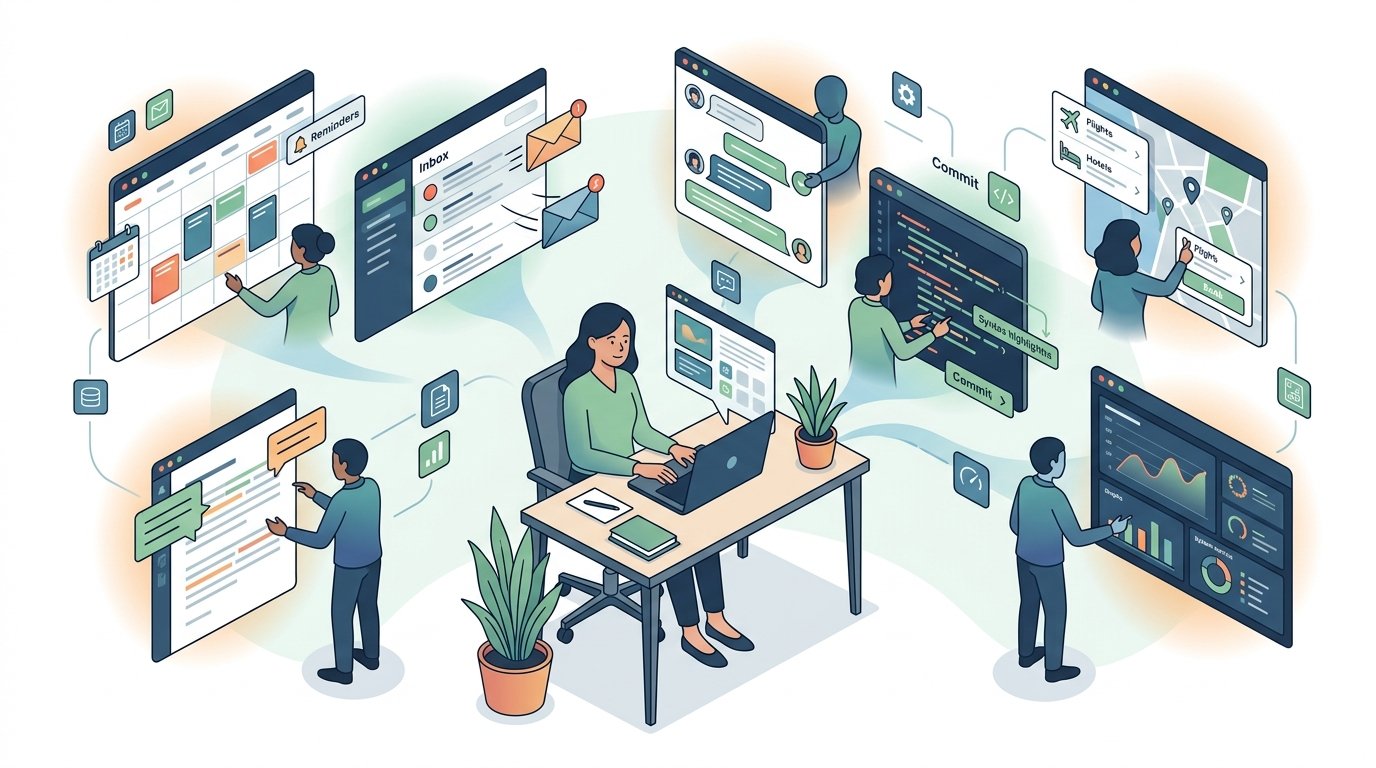
1. Personal productivity
This is one of the most obvious starting points.
A useful agent can help with things like:
- triaging email
- checking your calendar against travel or weather
- reminding you about obligations before they become urgent
- pulling together context across notes, tasks, and messages
- helping plan trips, meetings, or errands with less manual coordination
This is the kind of work people constantly do in fragments. None of it is glamorous, but all of it consumes attention.
If software can absorb even part of that burden, the value is immediate. Not because it is futuristic, but because it is practical.
2. Business operations
Inside a business, there is an enormous amount of repetitive coordination work that lives between systems rather than inside them.
That includes:
- gathering updates from multiple tools
- following up on open items
- preparing meeting context
- summarizing project state
- routing work to the right people
- surfacing risks before they become obvious
This is where agents can become especially useful, not because they replace operators, but because they reduce the amount of manual stitching required to keep work moving.
A lot of work in modern companies is really just context assembly plus follow-through. It is not deep strategy, and it is not raw execution. It is the connective tissue in between. That is exactly the kind of work agent-like systems may be able to help with.
3. Customer-facing work
Customer support is an obvious example, but the bigger story is broader than that.
Agent-like systems can help with:
- support triage
- onboarding guidance
- routing customers to the right path
- gathering missing information
- following up on routine issues
- handling simple requests without making the experience feel completely dead
The key is not just answering questions faster. It is helping move the customer toward resolution.
That said, this is also one of the places where weak agent design becomes obvious very quickly. A system that sounds fluent but cannot reliably resolve anything is not helpful. It is just an expensive delay layer.
4. Technical and product work
This is where a lot of the early excitement has come from.
AI agents can already be useful for:
- code assistance
- debugging support
- writing or updating documentation
- reviewing system state
- gathering implementation context
- helping with QA and repetitive product checks
Again, the value is not just that they generate text. It is that they can participate in actual workflows.
A technical team does not just need explanations. It needs help moving through real tasks: finding the bug, checking the logs, tracing the dependency, comparing environments, summarizing what changed, and making the next step easier.
That is a much more meaningful threshold.
Why this matters more than the hype
Most people do not need a software philosophy lecture. They need to know why this changes anything.
The answer is simple: it changes how much work software can absorb before a human has to take over.
Traditional software usually waits to be driven.
AI agents, when well-designed, can carry some of the burden of:
- coordination
- retrieval
- follow-through
- context assembly
- routine decision support
That is the real promise.
Not magic. Not full autonomy. Just software that can take on a little more of the work that used to fall entirely on people.
For an individual, that may mean less mental overhead.
For a team, it may mean fewer dropped balls.
For a business, it may mean less time wasted on repetitive handoffs and status-chasing.
Those gains are not flashy, but they are real.
And in practice, real value often comes from boring improvements made consistently, not from cinematic demos.
Where the hype breaks
This is also where the agent conversation needs more honesty.
A lot of what is called an AI agent today is still fairly narrow.
Some systems can take only a few predefined actions. Some are really workflows with an LLM layered in the middle. Some sound smart in demos but fall apart when context changes. Some create more supervision work than they remove.
This does not mean the whole category is fake. It means the category is early, messy, and frequently oversold.
There are a few reasons for that.
First, reliability is hard
It is one thing for a model to suggest a next step.
It is another for a system to consistently choose the right action, use the right tool, interpret the right context, and verify that the outcome actually worked.
That is a much higher bar.
Second, action is riskier than language
People are impressed when a model sounds fluent. But fluent language can hide weak execution.
The moment a system starts sending messages, updating records, triggering workflows, or moving information between tools, the cost of being wrong goes up.
That is why good agent systems need boundaries, approvals, recovery paths, and verification. Without those things, “autonomy” becomes a liability very quickly.
Third, many companies are stretching the label
A chatbot with a plugin gets called an agent. A workflow with three branches gets called an agent. A support bot with memory gets called an agent. A deterministic script wrapped around an LLM gets called an agent.
Sometimes those systems are useful. But the label alone does not tell you much.
That is why the better question is not “is this an AI agent?” The better question is “what can it actually do, under what conditions, with what reliability, and with what safeguards?”
That is the difference between marketing and architecture.
What good boundaries look like
One of the easiest ways to tell whether an agent system is serious is to look at its boundaries.
A good system is not just capable. It is controlled.
That usually means clear answers to questions like:
- What tools can it use?
- What actions can it take on its own?
- What requires approval?
- What memory does it preserve?
- How does it check whether something worked?
- When does it stop and escalate to a human?
These questions matter because action without control is not maturity. It is just risk with better branding.
The strongest agent systems are usually not the ones with the wildest demos. They are the ones that can operate usefully without becoming chaotic.
In other words, the important design problem is not “how autonomous can we make this?” It is “how useful can we make this while keeping it trustworthy?”
That is a better framing for almost every real-world use case.
What to look for when someone says they built an AI agent
If you are evaluating a product, a platform, or even your own internal system, here are better questions to ask than “does it have agents?”
1. What actions can it actually take?
Can it only answer questions, or can it also retrieve information, update systems, send messages, schedule work, or trigger workflows?
2. How much initiative does it really have?
Does it wait for step-by-step instructions, or can it move a goal forward on its own within defined boundaries?
3. What context does it preserve?
Does it remember anything meaningful across steps or sessions, or does every task effectively restart from scratch?
4. How does it verify outcomes?
Can it tell the difference between “I attempted an action” and “the action actually succeeded”?
5. Where are the human checkpoints?
What requires approval? What gets audited? What happens when the system is unsure?
6. Is it reducing work or just shifting it?
This is the most important question of all. If a system creates supervision overhead that outweighs the value it provides, it is not helping yet.
That does not mean it will never be useful. But it does mean the real work is not done.
The real reason this matters
The reason AI agents matter is not that they make software feel smarter.
It is that they change the relationship between software and work.
For a long time, software has mostly been passive. It stored, displayed, sorted, calculated, and responded. It was useful, but it generally waited for people to do the orchestration.
Agent-like systems begin to take on some of that orchestration.
That is the real shift.
It means software can start to participate in work that used to require constant human coordination. Not perfectly. Not universally. And not without risk. But enough to matter.
That is why this category keeps getting attention, even through the hype cycle. Because underneath the bad branding and the inflated promises, there is a real idea here: software that can do more than sit there and wait.
Final thought
The most useful way to think about AI agents is not as magic, and not as marketing.
Think of them as software systems that are beginning to cross a threshold, from answering questions to helping carry tasks.
Some will be overhyped. Some will be brittle. Some will just be workflows with better storytelling.
But some will be genuinely useful.
And the ones that matter will not be the ones that sound the smartest. They will be the ones that reduce real work, operate within real boundaries, and make people more effective without making the system harder to trust.
That is what makes AI agents worth paying attention to.
Comments